
 Nick Chasinov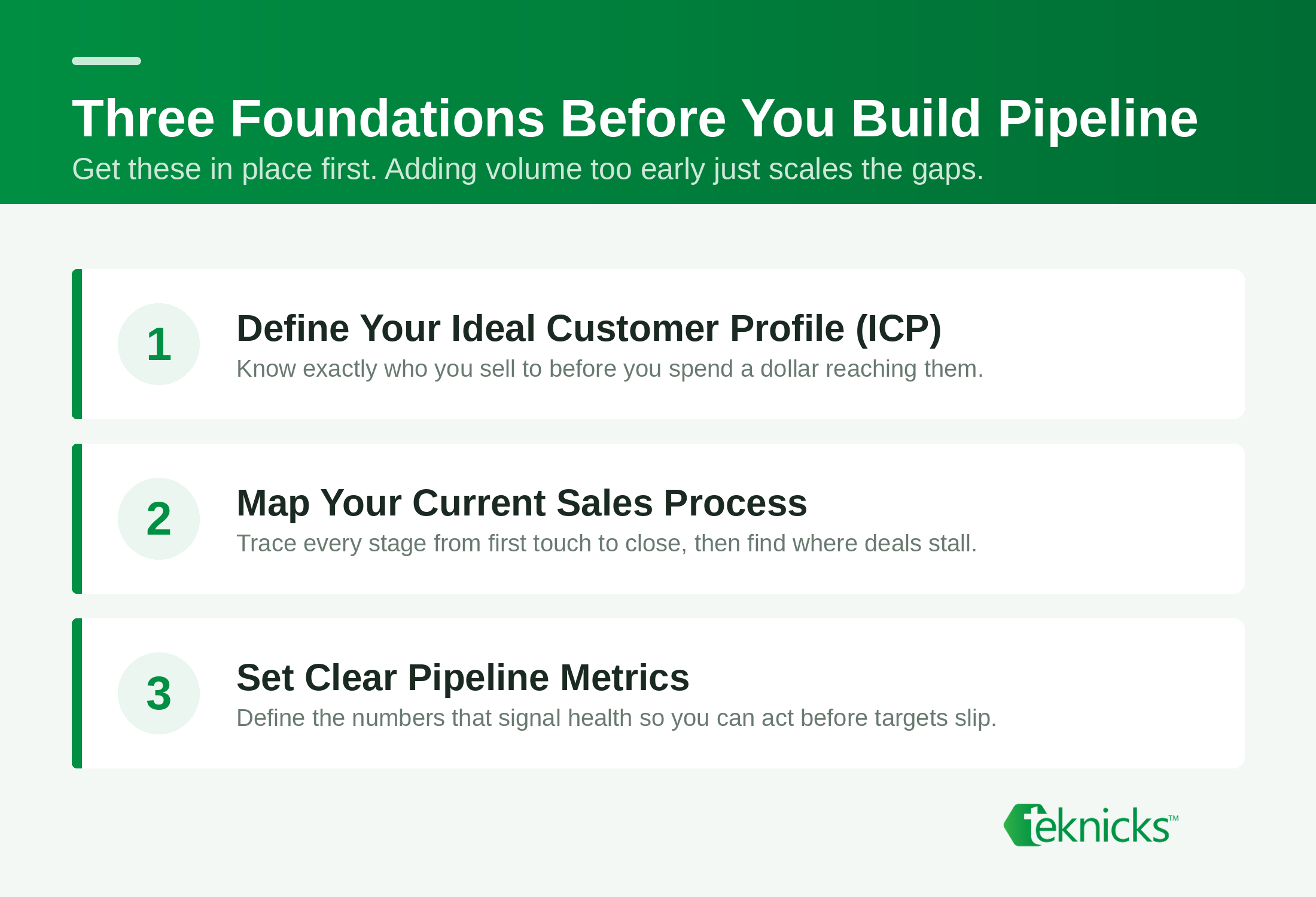
B2B pipeline feels unpredictable for a reason. Most teams focus on adding volume before the system is ready to handle it. The result is inconsistent pipeline, reactive planning, and pressure that resets every quarter. This post covers the foundations most teams skip, how aligning sales and marketing creates measurable impact, and the strategies that compound over time to build qualified, predictable pipeline.
What You Need To Do Before You Build Sales Pipeline
Most pipeline problems start before the first outreach goes out. Teams that struggle with consistency usually share the same gap: they build before the foundation is ready. Before you work to grow volume, three things need to be in place: a clearly defined ideal customer profile (ICP), a mapped sales process, and agreed-upon metrics. These form the diagnostic layer that separates predictable pipeline from reactive mode.
Define Your Ideal Customer Profile
A well-defined ICP goes beyond industry and company size. It includes buying triggers, decision-maker roles, common objections, and the specific outcomes your buyers are trying to achieve. Without it, outbound efforts are scattered, and inbound content attracts visitors who will never convert. The clearest way to sharpen your ICP is to pressure-test it against your last 10 closed-won deals. Look for real patterns, including buying trigger, role, deal size, and sales cycle length, not the assumptions your team built the ICP on in the first place.
Map Your Current Sales Process
Before adding more pipeline, it helps to map what already exists. Without a documented sales process, new opportunities surface broken handoffs and undefined stage criteria. Start by capturing every stage from first touch to close. For each stage, identify the entry and exit criteria, the typical activities, and who owns the handoff. Then look at where deals stall. That data tends to reveal whether your problem is a volume issue or a conversion issue. You cannot fix what you cannot see, and you cannot scale what is not documented.
Set Clear Pipeline Metrics
The metrics that matter are not the ones that show activity. They are the ones that show outcomes. Pipeline coverage ratio tells you whether you have enough opportunities to hit your number. Stage conversion rates reveal where deals are getting stuck. Average deal size and sales cycle length shape your forecasting and resourcing decisions. When sales and marketing teams measure different things, or define the same metric differently, reporting becomes unreliable and cross-functional alignment becomes harder. The teams that avoid this usually settle on shared definitions before they build the dashboard.
Align Sales and Marketing Around Pipeline
Pipeline problems are often sales and marketing alignment problems in disguise. When sales and marketing operate with different definitions of a qualified buyer, different success metrics, and no shared feedback loop, pipeline stays inconsistent regardless of how much activity is happening. Getting this right is not a one-time conversation. It requires a shared framework, regular communication, and accountability on both sides.
3 Strategies to Generate Qualified Pipeline
With the foundations in place, the next step is filling the top of the funnel. These three strategies are not one-off tactics. They work together as a system: using intent data to identify buyers who are already researching, running consistent outbound cadences to create qualified conversations, and optimizing the website to convert demand already in market.
1. Use Intent Data to Identify Ready Buyers
Intent data shows you which buyers are actively researching solutions like yours before they raise their hand. Sources like G2, Bombora, and behavioral signals in your CRM can surface accounts showing elevated interest. The goal is to prioritize where your outbound effort goes. When you focus sales and marketing attention on accounts already showing buying signals, your conversion rates improve, and your outreach lands better.
2. Develop a Consistent Outbound Cadence
Effective outbound is not built on a single touchpoint. It runs across multiple channels with consistent sequencing and timing. LinkedIn works well for connection requests, content engagement, and direct messaging with target accounts. Cold email enables direct outreach at scale, especially when personalized to ICP fit and buying triggers. Sequence these channels so your outreach feels coordinated, not repetitive. Cadence consistency matters more than raw volume. A prospect who sees your name across three channels is more likely to respond than one who received ten emails from a single source.
Build Credibility Before You Reach Out
A consistent cadence gets your message in front of the right accounts. What happens next depends on what those accounts find when they look you up. Before a prospect replies to a connection request or a cold email, they check who is reaching out. The first thing they see is your LinkedIn profile and the content attached to it. When that presence speaks to the buyer, outreach lands warmer. When it is built around your resume instead, the outreach works against itself before the conversation starts.
Optimize Profiles for the Buyer
Your profile should speak to your ICP, not to your own career history. The headline carries the most weight because it follows them into every comment, message, and connection request. A title like “Account Executive at [Company]” tells a buyer nothing. A headline that names who the rep helps and what changes for them does the qualifying work before the first reply. The About section should follow the same logic. Instead of a career timeline, it should describe the problems the buyer is facing and how the rep’s solution approaches them. The standard is straightforward: a buyer from a target account should be able to skim your profile in a few seconds and recognize their own situation in it.
Post Consistently
A clear profile opens the door. Consistent posting keeps it open. Those who earn the strongest responses tend to post regularly. They publish content that names the specific challenges their buyers are working through, then offer proof that those challenges are solvable. A short post on why chasing more leads can quietly hurt pipeline in a long buying cycle will resonate with the people living that problem. A real example alongside it, such as a metric that moved or a lesson from a deal that stalled, gives buyers a reason to trust the rep’s read on the situation. By the time the outreach arrives, the prospect has already seen your content as useful more than once. That is a very different conversation than one starting from zero.
Personalize Cold Email
The same principle applies to cold email. Generalized email does not perform, not because the channel is dead, but because buyers recognize a template in the first line. The emails that earn replies show that the work was done before the send: a reference to something specific about the company, a buying trigger worth noting, a pain point that maps to where the buyer is now. This does not require length. One genuinely personalized sentence at the top, tied to an ICP-relevant trigger, outperforms a polished template. The goal is a series of relevant, individual conversations, which is what dependable outbound has always been.
3. Optimize Your Website for Conversion
Traffic without conversion optimization builds pipeline slowly. Most B2B websites underinvest in conversion relative to the traffic they are already generating, which means the demand is arriving and leaving without ever reaching sales. The elements that move the needle are not complicated: a clear value proposition on high-intent pages, demo or meeting CTAs placed where buyers are making decisions, social proof that speaks directly to your ICP, and fast page load times. Run A/B tests on your demo request pages and CTA copy, and treat the results as a system.
The compounding is what makes this work. In one program, sustained testing against existing traffic produced a 368% year-over-year increase in user conversion rate and a 69% year-over-year increase in qualified demo requests. There were no new channels introduced or additional spend on demand generation. These were the same visitors, converting at a materially different rate. For most teams, this is also the easiest pipeline to win back because the traffic is already there.
3 Strategies to Convert and Accelerate Pipeline
Getting opportunities into the pipeline is only part of the equation. The other part is keeping the pipeline healthy and moving. Stale deals, misqualified opportunities, and metrics that track activity instead of outcomes can make a pipeline look full while actual revenue potential is declining. These three practices help teams convert opportunities more consistently, measure what matters, and accelerate deals without applying pressure that drives buyers away.
1. Audit and Clean Your Pipeline Regularly
A full pipeline and a healthy pipeline are not the same thing. Regular audits help you tell the difference. The process is straightforward: review each open opportunity against your defined stage criteria, remove or re-stage deals that no longer meet the bar, and look for patterns in where deals go dark. Most teams find a monthly or quarterly cadence is enough to stay ahead of it. A clean pipeline is more accurate. Accuracy leads to better forecasting, better resource allocation, and better conversations with leadership about where revenue is actually coming from.
2. Track the Metrics That Move the Needle
Not all metrics are equally useful. Stage conversion rates, time-in-stage, pipeline velocity, and close rate by source tell you where the system is working and where it is breaking down. Activity metrics like calls made and emails sent tell you how busy the team is. Focus your reporting on the metrics that inform decisions, not the ones that create noise and give a false sense of momentum.
3. Shorten Sales Cycles Without Rushing the Buyer
Shorter sales cycles come from better enablement, not artificial urgency. Tactics that genuinely accelerate buying decisions include mutual action plans that give the buyer a clear path to close, content delivered at the right stage that answers the questions buyers are asking internally, champions enabled with ROI data they can use to build the case, and clear next steps defined after every interaction. None of these rush the buyer. They remove friction. When buyers know where they are in the process and what comes next, decisions happen faster.
Build a System, Not a One-Off Sprint
Most pipeline-building efforts fail over time not because the tactics were wrong but because they were built as campaigns. When the campaign ends, the opportunities dry up. The teams with the most consistent pipeline are running a repeatable system that generates qualified opportunities quarter after quarter without starting from scratch. This section makes the case for building that system.
Move From Reactive to Repeatable
Reactive pipeline generation looks the same at most companies: scrambling at the end of the quarter, launching one-off campaigns, and relying on individual heroics to fill gaps. A repeatable system looks different. It has defined plays, documented cadences, ongoing measurement, and continuous iteration. The outputs do not depend on any one person’s effort level. They depend on the process. Repeatability is what makes pipeline predictable.
Create a Full-Funnel Growth System
A full-funnel growth system connects every layer: awareness and intent capture at the top, conversion and nurture in the middle, and sales enablement and pipeline acceleration at the bottom. Each layer feeds the next. When one layer is missing or disconnected from the others, the whole system underperforms. Building this architecture is what turns qualified pipeline from a lucky outcome into a repeatable one.
How Teknicks Helps You Improve Sales Pipeline
Teknicks works with B2B marketing leaders to build pipeline systems. Our work starts with full-funnel visibility: understanding what drives real demand, where conversion breaks down, and what the data actually say about buyer behavior. From there, the focus shifts to building the repeatable growth infrastructure that keeps pipeline moving quarter over quarter.
Our team is senior-only. This means no junior handoffs, only direct access to strategists with 20+ years of data-driven experimentation behind our decisions, and full accountability to outcomes.
If you are ready to stop guessing and start building, schedule a free strategy call with a senior strategist.