
 Nick Chasinov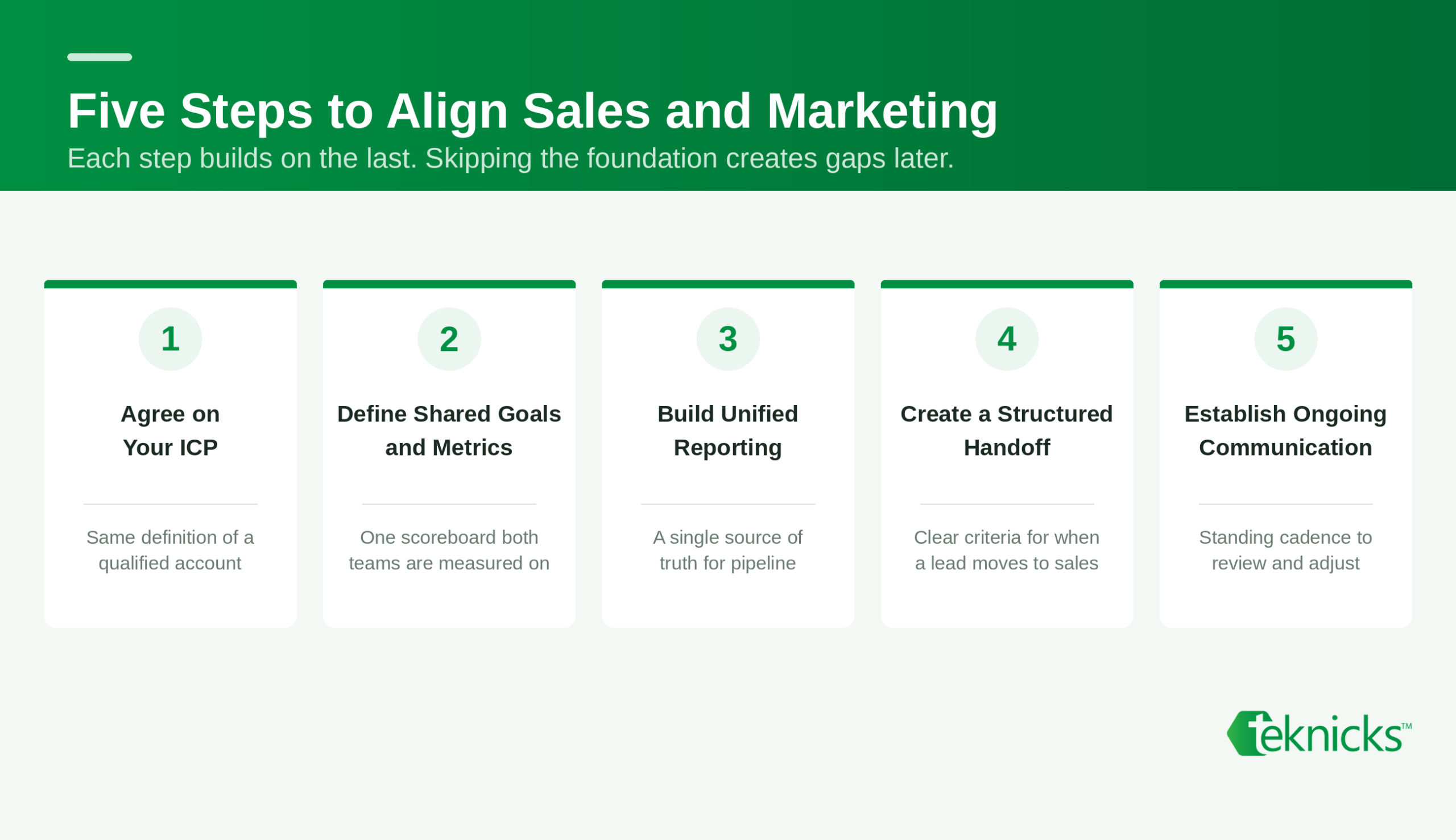
Marketing and sales teams share accountability for pipeline, but often operate with different data, definitions, and ideas of what success looks like. Marketing tracks engagement and volume. Sales tracks deal stages and close rates. When those systems do not connect to a shared view, the result is predictable: missed pipeline opportunities, attribution gaps that neither team can explain clearly, and growing friction over who is responsible for what.
This post covers the root causes of that misalignment, practical steps to build a shared operating model, and sales and marketing alignment best practices. This way, both teams run as one connected system.
What Is Marketing and Sales Alignment?
Marketing and sales alignment is a shared operating model in which both teams work from the same data, definitions, and goals. It is not a communication fix or a culture initiative. According to Forrester, 65% of sales and marketing professionals report a lack of alignment between their leaders. That gap is structural. True alignment is built into how both teams operate, not negotiated on a meeting-by-meeting basis.
Why the Gap Between Teams Exists
Marketing and sales drift apart because they are built to measure different things. Marketing optimizes for engagement and volume. Sales optimizes for close rates and revenue. When those metrics do not connect to a shared view, both teams are effectively operating on different scorecards.
The gap grows when data systems are separate, and handoffs lack shared definitions. Attribution becomes murky, and neither team can fully explain what is driving or stalling pipeline. In HR tech, the multi-stakeholder buying committee widens that gap further: the person who downloaded the compliance guide is rarely the person who signs the contract. That is a systems problem, not a people problem.
What Alignment Actually Looks Like in Practice
A well-aligned operation shares three things:
- A common definition of a qualified opportunity
- A single reporting view across the full funnel
- A structured cadence of cross-team check-ins tied to pipeline data
Marketing is not handing off volume and hoping for conversions. Sales is not rejecting leads without a feedback loop. Both teams review the same data, ask the same questions, and adjust based on what it shows. That is what operational alignment looks like day to day.
Why Marketing and Sales Alignment Matters
Misalignment is expensive. Marketing spend goes toward demand that sales cannot convert. Opportunities fall through the cracks due to handoffs that were never clearly defined. And when leadership asks what is driving revenue, both teams point at different numbers.
This cost compounds where buying cycles are long and committees are large. When the gap between first touch and closed revenue can stretch six to twelve months and span six to twelve stakeholders, attribution is already difficult. Add misalignment, and it becomes nearly impossible to identify what is working, what is not, and where to invest next.
The Pipeline Impact of Misalignment
When marketing and sales are not aligned, pipeline leaks. Marketing generates volume that does not meet sales’ definition of qualified. Opportunities fall through at handoff because no one owns what happens next. Reporting shows activity, but cannot show which activity is actually converting.
For marketing leaders under pressure to prove contribution, that gap is a serious problem. Every pipeline review becomes a debate about whose numbers are right rather than a decision about what to do next.
How Alignment Affects Long Buying Cycles
Long buying cycles make misalignment more costly because attribution gaps compound the longer a deal runs and the more touchpoints a committee accumulates. Each handoff as the deal progresses is a risk point when there is no shared process in place. Sustained alignment is not optional in complex buying environments. It is the operational foundation that keeps pipeline predictable across the full length of the cycle.
Common Obstacles to Marketing Sales Alignment
Most alignment problems come down to three structural obstacles:
- Disconnected data systems
- Undefined pipeline criteria
- Poorly designed handoffs
Identifying which one your organization is dealing with is the starting point.
Disconnected Data and Attribution Gaps
When marketing and sales run on separate platforms with no clean integration, attribution breaks down. Marketing cannot trace which efforts influenced a specific buyer. Sales cannot see what touchpoints preceded a qualified opportunity. Reports tell different stories depending on who pulls them.
The consequence is decisions made on incomplete data. The budget is allocated without clear visibility into its impact, and the efforts that are actually working do not receive the recognition or investment they deserve.
No Shared Definition of Qualified Pipeline
When marketing and sales define a qualified opportunity differently, friction at handoff is guaranteed. Marketing optimizes for volume; sales applies its own criteria and rejects what comes through. Neither team is wrong. They are simply working from different definitions.
A shared definition is one of the highest-leverage fixes available. It should include specific behavioral and firmographic criteria, grounded in real data rather than aspirational personas, and agreed upon by both teams.
The hard part is rarely writing the definition. It is getting sales to agree to it and hold to it. A sales leader who may outrank or out-tenure you has little reason to sign up for stricter criteria that shrink the lead count they can point to. The move that works is not a mandate from marketing. It is building the definition from their own closed-won data and bringing that to the table, so it reads as a shared discovery rather than an imposed constraint. Anchored in deals they already won, the conversation shifts from whose fault the bad leads are to what a good one actually looks like.
Weak Handoff Processes Between Teams
A weak handoff looks like this: marketing marks a contact as ready for sales with no documented criteria, no agreed-upon next step, and no feedback loop. The opportunity stalls or gets rejected, and marketing never finds out why.
Consider an HRIS or ATS vendor with strong demo request volume but a low close rate. The problem is usually not the volume. It is that the demos come from HR generalists exploring options, while the economic buyer, such as a CHRO or CFO, was never brought into the conversation. No one defined what a sales-ready opportunity looks like before the handoff.
Steps to Align Sales and Marketing
These steps are a sequence, and each one builds on the last. Skipping the foundational work around shared ICP and definitions creates gaps that no reporting system or communication cadence can compensate for later. The goal is to build the operational infrastructure that makes alignment a functioning system.
1. Agree on Your Ideal Customer Profile
Alignment starts with a shared, documented ideal customer persona. When marketing and sales do not agree on who they are targeting, every decision diverges. Marketing creates content for one buyer, potentially highlighting the wrong pain points. Sales pitches a different one.
A working ICP is specific, behavioral, and grounded in data. It is built from closed-won deals and actual buyer behavior, not job titles assembled in a planning session without sales in the room.
The richest source for that detail is sitting in your sales team’s call recordings. The objections reps hear repeatedly, the questions that stall a deal, the pain points buyers describe in their own words, and the exact vernacular they use are first-party gold. When a prospect says “we’re drowning in manual onboarding” rather than “we lack workflow automation,” that phrasing is data. It tells you how the buyer frames the problem, which is how your content should frame it back.
Build a habit of mining sales calls for this. What objections come up before a deal closes, and what finally overcomes them? Which compliance or security concerns surface, and from whom? What language do buyers use to describe the status quo they’re trying to escape? Feeding those answers back into content and sales material gives marketing the precise pain points and vocabulary to lead with, so what a prospect reads sounds like the conversation they’d have with your best rep.
2. Define Shared Goals and Metrics
Both teams need goals they can both be held accountable to. That means moving away from activity metrics, such as volume, clicks, and MQLs, and toward outcome metrics: qualified pipeline, conversion rates, and pipeline influenced.
For marketing leaders, this is the live credibility battle. The MQL is easy to generate and easy to dismiss; when an HR generalist downloads a benefits checklist, that is interest, not intent. Tying your contribution to qualified pipeline, such as committee engagement, sales-accepted opportunities, and influenced revenue, is what ends the “your leads are bad” argument with sales for good.
3. Build a Unified Reporting System
A unified reporting system means both teams see the same data, from first touch to closed revenue; not separate dashboards with different stories, but one view of what is happening at every stage. When marketing and sales pull different numbers, no one has a complete picture; a shared view gives both teams and leadership a single source of truth for pipeline decisions.
This is also where the payoff becomes tangible for you specifically. When marketing and sales present from the same view, you walk into the quarterly review with numbers no one disputes. The meeting stops being a referendum on lead quality and becomes a working session on where to invest next. That shift, from defending your contribution to directing it, is the moment when alignment stops being an operations project and starts being a source of leverage for your role.
4. Create a Structured Handoff Process
A structured handoff process includes four components:
- Defined qualification criteria
- Documented steps
- Clear ownership at each stage
- A feedback loop so marketing learns what happens after the handoff
Without them, pipeline leaks at the transition point, even when marketing is generating the right demand. The feedback loop matters most: it is what lets marketing adjust based on what sales is actually seeing.
5. Establish Ongoing Cross-Team Communication
Ongoing alignment requires a structured communication cadence, not more meetings. The goal is a regular review, tied to data rather than status updates, where both teams examine what is working, what is not converting, and where the handoff is breaking down. What changed in the funnel? Where are buyers dropping off? What is sales hearing from the committee that marketing should know? Review frequency should match the pace of the buying cycle: the longer the cycle, the more important it is to stay calibrated rather than waiting for quarter-end surprises.
Best Practices for Sustaining Alignment
Getting aligned once is a start. Staying aligned as goals shift, buying behavior changes, and teams evolve is the harder part. The two practices below are operating principles that compound in value the longer they are embedded into how both teams plan, report, and communicate.
Connect Data Across the Full Funnel
Full-funnel data connectivity is the foundation of sustained alignment. Linking every stage of the buyer’s journey lets both teams see which channels and content influence buyers, where conversion breaks down, and how marketing activity connects to revenue. This is about attribution clarity, not cleaner dashboards. Without it, marketing cannot prove its impact, and both teams end up with a partial picture of what is actually working.
Tie Marketing Activity to Pipeline Outcomes
Marketing teams that measure activity without connecting it to pipeline outcomes lose credibility with sales and leadership over time. Volume and engagement metrics are easy to produce; pipeline contribution is what matters. Mapping content and campaign performance to conversion data shifts the conversation from “here is what we did” to “here is what we contributed,” which is the shift that earns trust.
How Teknicks Supports Marketing and Sales Alignment
Aligning sales and marketing is not complicated in theory, but it can be difficult to build and sustain in practice, especially for lean marketing teams under pressure to prove impact.
At Teknicks, we operate as a senior-level extension of your marketing team. Senior strategists are embedded directly into every campaign, not layered behind account managers.
If you are dealing with misalignment, schedule a strategy meeting to talk through your specific challenges with a senior strategist.