
 Matthew Campion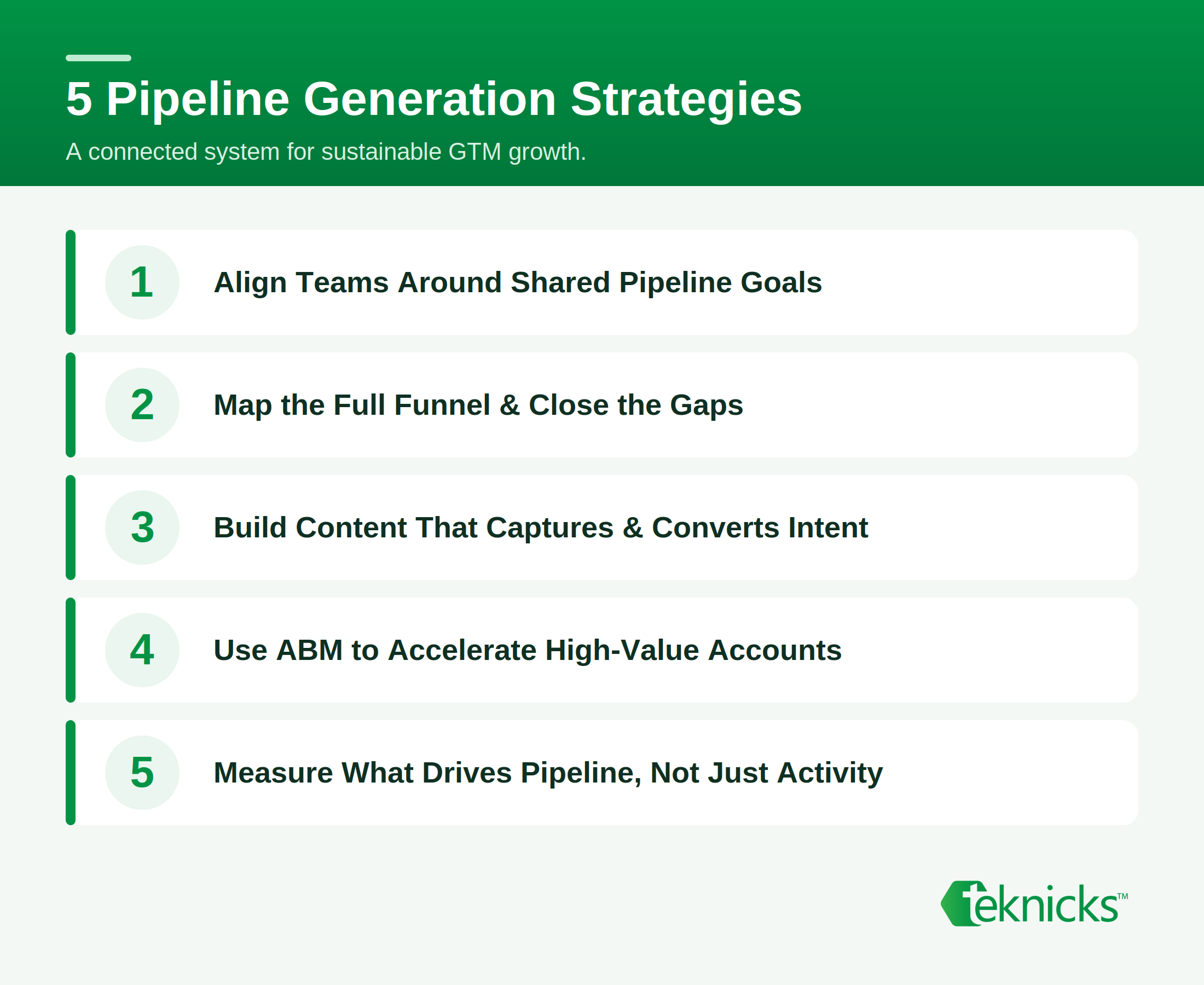
If you lead a GTM team right now, you already feel it: the bar has moved. Building pipeline your sales team can count on is the outcome everyone is measured against, and the expectations keep climbing faster than budgets or headcount. Traffic isn’t really the problem anymore. Most teams can generate it. The hard part is turning that traffic into qualified opportunities your sales team actually wants to act on.
This guide walks through what a mature pipeline generation system looks like, and how to build one that gets stronger every quarter instead of resetting. The goal is a repeatable approach you can rely on, not another tactic that works once and fades.
What Is Pipeline Generation?
Pipeline generation is the process of building a steady, reliable flow of qualified opportunities, from a buyer’s first moment of awareness to a conversation your sales team is ready to have. It’s worth being clear about what it isn’t. It isn’t lead generation, it isn’t traffic growth, and it definitely isn’t a spreadsheet full of names.
This is where many GTM teams get stuck. It usually isn’t for lack of effort. The available metrics reward activity, so that’s what gets measured. Clicks, form fills, and MQL counts all go up and to the right, but no one can draw a straight line from any of them to revenue. Pipeline generation asks a sharper question, “What is actually moving qualified buyers closer to a decision?”
Think of it as a system rather than a campaign. It covers the full arc, from the moment a buyer signals intent to the moment a qualified opportunity lands with sales. And it’s built for how B2B buying actually works, where people research quietly for months before they ever raise their hand. A mature approach is designed around that reality.
Why Pipeline Generation Matters for Long-Term Growth
Treating pipeline generation as a system is the line between predictable growth and a quarterly scramble. The pressure to show results every quarter is real, but running pipeline like a series of one-off campaigns quietly undermines the long-term predictability the business actually depends on. Two outcomes make the case for a systematic approach, and we’ll take them one at a time: more reliable revenue forecasting and a healthier relationship between sales and marketing.
Predictable Revenue Starts With Predictable Pipeline
Pipeline consistency and revenue predictability are tied together more tightly than most teams realize. When pipeline is reactive and volume-driven, forecasting turns into guesswork. Leadership can’t hire with confidence. Finance can’t build a model anyone trusts. And every quarter becomes another late-stage rush to close the gap.
A systematic approach changes the math. When pipeline generation is grounded in real intent signals and full-funnel visibility, patterns start to surface, the kind you can actually plan around. Conversion rates settle. Forecasts get sharper. The team stops reacting to results and starts seeing them coming. That move from chaos to consistency is what lets a team scale on purpose.
Marketing and Sales Alignment Becomes Easier
Most friction between marketing and sales comes down to a single tension: marketing is sending over volume, and sales is questioning the quality. When pipeline generation becomes a shared system, with a definition of “qualified” that both teams agree on, that tension starts to ease.
In practice, shared pipeline goals look like agreed-upon qualification criteria, pipeline reviews that both teams sit in on, and reporting that nobody quietly disputes. The conversation stops being about who’s to blame for the miss and starts being about what’s actually converting downstream, not just what’s pouring into the top of the funnel. If this is your sticking point, we’ve written more on sales and marketing alignment.
What Makes Pipeline Generation So Challenging?
Most GTM leaders already know pipeline matters. Knowing isn’t the hard part, but execution is. Three structural problems tend to slow pipeline generation down for teams working in complex B2B markets. None of them are signs you’re doing the job badly. They’re common, they’re understandable, and naming them is the first step toward building a system that works around them.
1. Attribution Blindness Slows Decision-Making
Attribution blindness sets in when marketing and sales can’t agree on what’s driving pipeline, when your reporting shows clicks and sessions instead of influence and conversion, and when budget calls get made on half of the picture.
The cost shows up downstream: slow decisions, money spent in the wrong places, and an uncomfortable silence when an executive or board member asks what’s really working.
Here is a quick example to make it concrete:
Marketing reports that a webinar drove 200 MQLs. Sales says none of them were real. Six months later, three closed deals turn out to share one thing in common: every buyer attended that webinar, but the system credited them all to “direct/organic.” Attribution blindness didn’t just create confusion in that meeting. It hid the thing that was working. Full-funnel attribution clarity is what lets you stop guessing and start deciding based on what’s genuinely influencing buyers.
2. Long Buying Cycles Complicate Timing
Complex B2B sales have a timing problem that standard marketing metrics simply weren’t built to handle. Buyers are researching for months before they engage with anyone. A channel that looks like a dud in a 30-day window might be planting the influence that closes a deal six months out.
Standard benchmarks were never designed for cycles that long. GTM teams need attribution and reporting frameworks shaped around the actual length and messiness of their buyers’ journeys. Without that, it’s easy to cut what’s working and pour more into what isn’t.
3. Misaligned Teams Drain Pipeline Momentum
Here’s the frustrating part: marketing and sales can each be doing good work and still leave gaps that bleed pipeline. Handoffs slip. Qualified opportunities stall because no one clearly owns the next step. The story marketing tells doesn’t quite match what sales says on a call.
The cost of that misalignment compounds in lost deals, distorted data, eroding morale, and leadership pressure that climbs quarter after quarter. Misalignment rarely holds steady. Left alone, it gets more expensive every cycle.
5 Pipeline Generation Strategies for GTM Teams
These strategies are most powerful when used as a connected system, not as a checklist you work through and forget. Strong pipeline generation starts with clarity about who you’re targeting, adds qualification criteria to keep your team’s effort focused, and aligns sales and marketing around shared goals and execution. Each one builds on the last.
1. Align Teams Around Shared Pipeline Goals
Getting sales and marketing to agree on what a qualified pipeline opportunity actually is. That’s the foundation everything else rests on. Skip it, and pipeline generation stalls at the handoff no matter how well each team performs on its own.
Concretely, shared pipeline goals mean agreed-upon qualification criteria, pipeline reviews that both teams attend, and reporting that both teams believe. Sales and marketing alignment isn’t a cultural aspiration you put on a slide. It’s an operational requirement for predictable pipeline.
2. Map the Full Funnel and Close the Gaps
Funnel mapping has to start with a clear picture of your ICP. Without knowing who you’re trying to reach, segment, and convert, a funnel map is just a tidy diagram with no targeting behind it.
So start there. Define who the ICP is, what they’re trying to get done, and where they sit in the buying journey. Then map the whole funnel, from awareness through closed-won. Find where qualified opportunities are coming in, where they’re getting stuck, and where they’re quietly leaking out.
Defining your ICP is an operational decision that shapes everything downstream, from the channels you pick to the content you build to the criteria you hand off.
3. Build Content That Captures and Converts Intent
Not all content does the same job, and it helps to be honest about which job each piece is doing. Content that captures intent meets buyers where they’re already researching, answering the specific questions they’re asking long before they’re ready to talk to sales. Content that converts intent takes a qualified buyer and gently moves them toward the next step.
Most GTM teams over-invest at the top of the funnel and under-invest in the middle and bottom, which is exactly where intent runs highest and pipeline impact is most direct.
At Teknicks, we close that gap by working alongside your sales team to understand the real questions your ICP is asking at each stage. The questions that come up repeatedly often make excellent FAQ content. Sales calls carry the actual language your buyers use, and borrowing that vernacular is what makes content land. Pain points and challenges are naturally woven into landing pages and ads, and every piece maps to where the buyer actually is in their journey. From there, we measure what we should have been measuring all along: which content influences pipeline, not just which content racks up traffic.
4. Use ABM to Accelerate High-Value Accounts
Account-based marketing only pays off when you know which accounts are worth your attention. That’s where lead scoring earns its keep. Before you run any account-based motion, you need a clear model for identifying and scoring the accounts with the most potential, based on ICP fit, intent signals, and engagement.
Lead scoring lets a team allocate its time and budget to the opportunities most likely to convert, rather than spreading effort evenly across a long target list. That discipline is what makes ABM efficient. And efficiency is what separates pipeline quality from pipeline volume.
5. Measure What Drives Pipeline, Not Just Activity
Measurement isn’t the last step you bolt on at the end. It’s the discipline that makes every other pipeline generation strategy here smarter over time.
Pipeline-focused measurement means tracking conversion at each stage of the funnel, attributing pipeline influence rather than crediting the last click, and building reports that answer the questions your executives and sales leaders are really asking. That question isn’t “How much traffic did we get?” It’s “What’s actually driving qualified pipeline?” Build your reporting around that, and every other strategy on this list gets better.
Build a Pipeline Generation Plan That Compounds
The value here was never in any single tactic. It’s in the compounding effect of a system where ICP clarity, lead scoring, team alignment, content, and measurement all reinforce one another. Each piece does more in combination than it ever could on its own.
A maturing pipeline generation system tends to look the same way quarter after quarter: better data, tighter qualification, more efficient conversion. It takes time and a bit of discipline. But it’s the difference between a team that resets every quarter and one that scales with confidence.
You don’t have to build the perfect system on day one. The point is to lay a foundation that gets smarter with every cycle. Teams that commit to this stop starting over. They start compounding, and that’s what a real pipeline generation plan looks like in practice.
Ready to Build a More Predictable Pipeline?
Building a pipeline generation system isn’t a quick fix, and we won’t pretend otherwise. Senior GTM leaders are working through real complexity: long buying cycles, teams that don’t always line up, attribution gaps, and the steady pressure to prove impact every quarter.
If you want to talk through your specific pipeline challenges with someone who’s worked through them before, we’re glad to have that conversation.
Schedule a free strategy call with a senior strategist at Teknicks and walk away with a clearer view of where your pipeline generation system has room to grow.