
 Alyssa Kulka
You've decided to bring in outside help with AI search. Now the question is when.
Your buyers ask ChatGPT, Perplexity, and Google AI Overviews which vendors to consider before they ever visit your site. You may hear this work called generative engine optimization (GEO), answer engine optimization (AEO), or AI search engine optimization (SEO). All three aim for the same thing: getting your brand named and recommended in AI answers.
This guide covers the signs to check in your own data, when waiting is smarter, and what the first 90 days with an agency look like.
AEO vs. SEO vs. GEO: What's the Difference?
Agencies use these terms loosely, so here's what each one means.
| Approach | What It Aims For | Where It Shows Up | What You Measure |
|---|---|---|---|
| SEO | Rank in search results and earn clicks | Google and Bing results pages | Rankings, traffic, and conversions |
| AEO | Become the direct answer to a question | Featured snippets, voice assistants, and Google AI Overviews | How often your content is the answer shown |
| GEO | Get named and recommended in AI-written answers | ChatGPT, Perplexity, Gemini, and Google AI Mode | How often AI tools mention and recommend you |
AEO, SEO, and GEO run on the same foundation: a healthy site, useful content, and a reputation other sites vouch for. AEO and GEO overlap so much that many teams, ours included, treat them as one program. If your SEO is already strong, you have a head start on the other two.
When Should You Hire a GEO Agency?
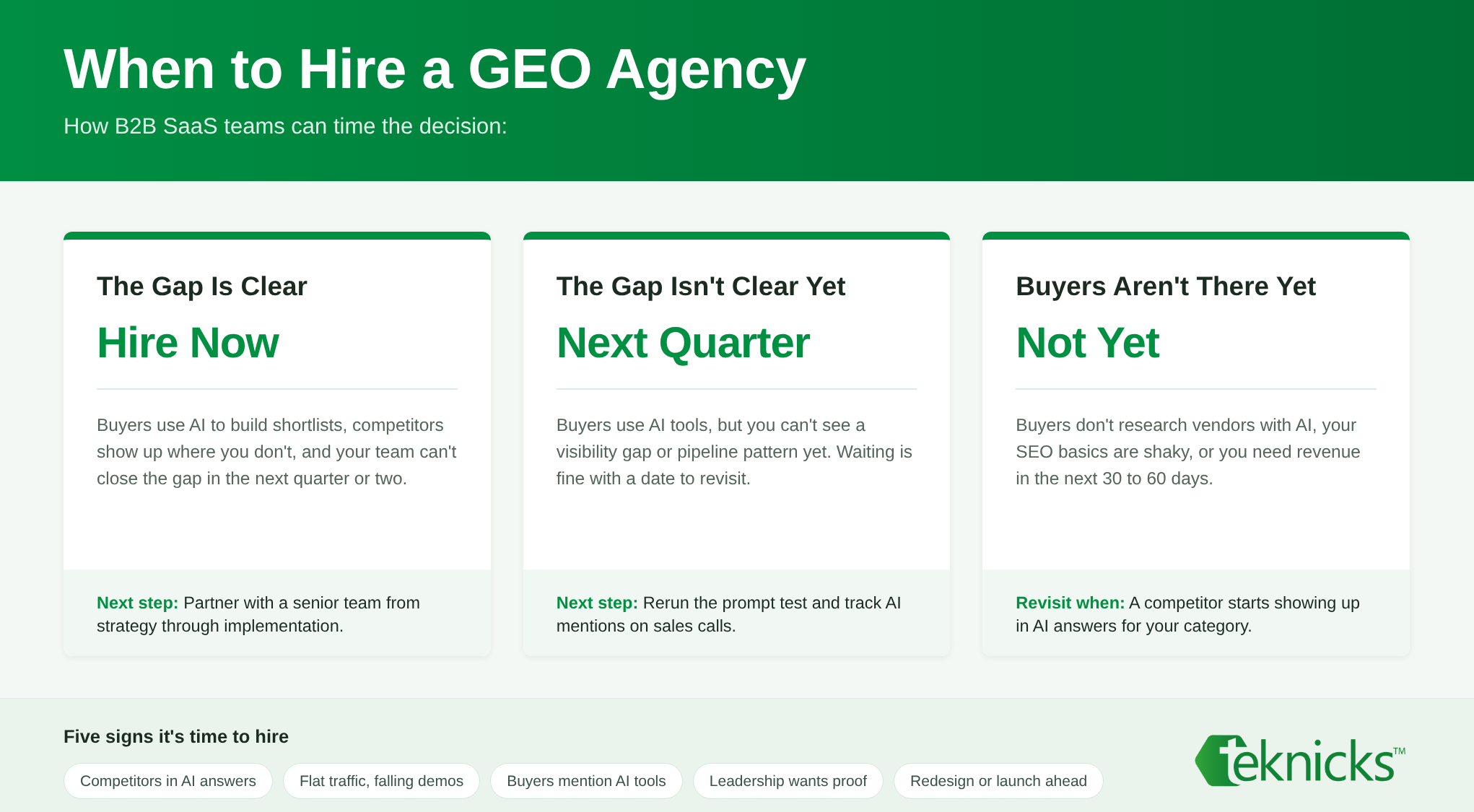
Hire a GEO agency when three things are true at once:
- AI answers already shape which vendors your buyers consider
- Competitors show up in those answers more often than you do
- Your team can't close that gap on its own in the next quarter or two
Good GEO services get your brand mentioned and recommended in AI answers, then connect that visibility to pipeline. The second part matters most. Being named is a start. Bringing in qualified buyers is the goal.
5 Signs It's Time to Hire a GEO Agency
So, when do you need a GEO agency? Each sign below is something you can check in your own data or sales conversations this week.
Competitors Show Up in AI Answers, and You Don't
Type 10 to 15 buyer questions, like “best [category] software for mid-market teams,” into ChatGPT, Perplexity, and Google AI Mode. Write down which companies get named.
If two or more competitors appear and you don't, that's the clearest signal. The gap also tends to grow, because AI tools keep pulling from the sites that already mention those competitors.
Organic Traffic Is Flat, but Demo Requests Are Falling
Your rankings and site visits hold steady, but demo requests and sales-ready leads slide. In Google Search Console (GSC), your pages show up more often but get clicked less.
Buyers are getting answers inside AI tools without clicking through. They show up later with their minds made up, or not at all. Traffic looks fine while pipeline shrinks.
Buyers Mention AI Tools on Sales Calls
Ask your sales team: are prospects saying “ChatGPT recommended you” or “Perplexity listed you next to [competitor]”? Those offhand comments are data.
Add an “AI tool” option to your “How did you hear about us?” field or post-demo survey. If buyers in your space research this way and you can't see it, you're likely losing ground you can't measure.
Leadership Wants Pipeline Proof This Planning Cycle
Your CEO wants to know what the company is doing about AI, and your CFO wants to know where new pipeline will come from.
If results need to show up within two quarters, can your team build this skill set and prove impact that fast? If not, an agency closes the time gap with a system that already works.
A Redesign, Migration, or Category Launch Is Coming
Most teams miss this window. A redesign, platform move, product launch, or new market is the cheapest time to build GEO in.
AI tools favor clear site structure, consistent descriptions of what you sell, and comparison pages. That's far easier to plan from the start than to rework after launch, so bring a partner in before the project is scoped.
What Waiting on GEO Costs You
GEO builds on itself. The brands AI tools mention today earn more coverage, reviews, and links, and that gets them mentioned again tomorrow. Start late, and you're catching up to a competitor who's already settled in.
Moving too early has a cost, too. Budget spent before your site can support the work rarely pays off.
So waiting a quarter is fine, as long as it's a decision with a date to revisit. In our Search-to-Pipeline methodology, this is the Compound stage, where gains finally show up in pipeline.
When It's Too Early to Hire a GEO Agency
Sometimes the honest answer is “not yet.” Hold off if any of these are true:
- Your buyers don't use AI tools to research vendors yet. Run the test from the first sign above. If no one in your space shows up, check each quarter again.
- Your product is still finding its market. GEO amplifies demand that already exists. It can't create it.
- Your SEO basics are shaky. Fix technical issues and core content first, or work will stall.
- No one can share analytics, CRM, or sales data. Without it, no partner can measure where you start or prove progress.
- You need revenue in the next 30 to 60 days. GEO builds over time. It isn't a quick win.
While you wait, work with sales to list the questions buyers ask most. Revisit when a competitor starts showing up in AI answers for your category.
In-House vs. Hiring a GEO Agency: Which Is Faster?
On speed alone, hiring a GEO agency usually wins.
Building in-house means recruiting for a skill set that barely existed two years ago. Experienced people are scarce, hiring takes months, and new hires need time to ramp up. One hire also rarely covers strategy, content, and the technical fixes in your codebase, where most developers aren’t trained on what AI tools need.
Speed also depends on who does the work. Some agencies hand over recommendations and leave your team to carry them out, which just moves the backlog. If an agency’s answer to “who does the work?” is “your team,” you’re paying for advice, not results. The right partner takes GEO from strategy through implementation, so changes go live quickly instead of ending up in the backlog.
In-house makes sense when GEO is a long-term, full-time need and your team has time to build it. A hybrid approach also works; an agency sets up the system while your team learns to run it.
What to Expect in the First 90 Days With a GEO Agency
Here's what a strong start looks like, using our Search-to-Pipeline stages:
- Map. Identify the questions buyers ask AI tools in your category and record where you stand today.
- Capture. Build or improve the pages AI tools pull from, like comparisons, alternatives, and “best of” lists.
- Influence. Start earning mentions on the review sites, publications, and communities AI tools trust.
Reporting should also go live, connecting AI-driven visits to sales opportunities. Visibility usually starts moving within 60 to 90 days. Pipeline impact follows your sales cycle.
One healthcare compliance software company saw a 1,476% increase in AI-feature impressions and a 60% increase in leads from organic and AI search within three months.
Good programs start building in month one. They don't spend a full quarter on audits.
What to Look For Before Hiring a GEO Agency
Reddit and Quora are full of marketers asking whether GEO is just the latest agency pitch. It's a fair question. Use this checklist to separate real partners from the rest.
- Do senior strategists actually perform the work, or are they only present for the sales call?
- Will they measure your baseline before starting, so you can clearly prove progress?
- Do their reports distinguish between brand mentions and recommendations, and connect both directly to pipeline impact?
- How easily does GEO integrate with your SEO services and CRO services, ensuring a unified strategy rather than siloed tactics?
Walk away from anyone who guarantees placement in AI answers or prices by the number of deliverables. You want real people, real accountability, and no gatekeepers.
How to Decide If Now Is the Right Time
It comes down to three questions:
- Are buyers in our space using AI tools to build their evaluations?
- Do we see a visibility gap or one of the pipeline patterns above?
- Can our team close that gap on its own in the next quarter or two?
Answering yes to all three means you should hire an agency now. If the answer to the first two is yes, but your team can handle it, plan for next quarter. If buyers aren't using AI tools yet, wait until competitors begin appearing in AI search results.
The goal is a decision you can confidently explain to your CEO.
Request a strategy session to pressure-test your timing with a senior strategist.
Frequently Asked Questions
How Long Does It Take a GEO Agency to Show Results?
Visibility usually starts improving within 60 to 90 days. Pipeline impact takes longer because it follows your sales cycle. Visibility leads, and pipeline follows.
How Much Does It Cost to Hire a GEO Agency?
The cost to hire a GEO agency depends on scope, market crowding, how much usable content you have, and how detailed your reporting needs to be. For actual ranges by delivery model, see our full guide to generative engine optimization cost.
Is It Too Late to Start GEO?
No, it is not too late to start GEO. Most markets are still early, and AI answers shift as the models update, so late starters can still catch up. The longer competitors hold those mentions, though, the more work it takes to win them back.
Should We Fix Our SEO Before Hiring a GEO Agency?
GEO and SEO share the same foundation: site health, content, and reputation, so a weak foundation slows GEO down. But you don't have to finish one before starting the other. A good partner fixes both in one plan.
Who Handles Implementation?
Implementation depends on the agency. Some agencies hand over a roadmap and leave the work to your team. At Teknicks, we handle everything from strategy to implementation on your website, including pages, schema, tracking, and tests. A roadmap only increases pipeline once the work is live.
Already have people responsible for your website? We work directly with them to deliver recommendations, answer questions, and run a final QA before anything launches.