
 Alyssa Kulka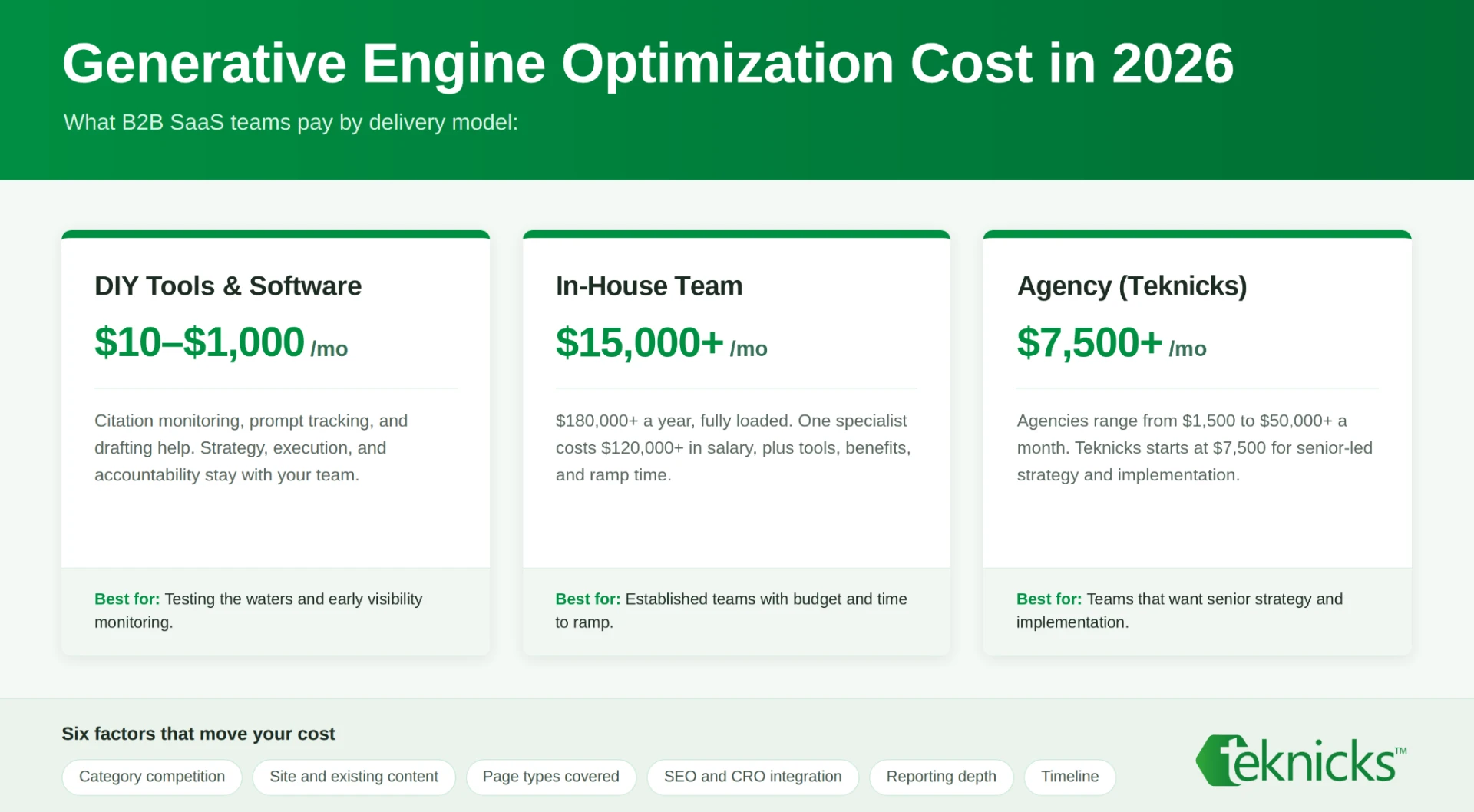
Your buyers are finding vendors inside AI answers now. They ask ChatGPT for contenders and skim Perplexity summaries and Google AI Overviews before they ever click a link. That shift creates a budgeting problem. Generative engine optimization cost is now a line item you have to defend, and there are almost no benchmarks to anchor it.
This guide breaks down the cost ranges you can expect in 2026, what drives them, and how to budget with confidence. Explore the numbers, the trade-offs, and a straight answer on what fits your situation as a B2B SaaS marketing leader.
How Much Does Generative Engine Optimization Cost in 2026?
In 2026, generative engine optimization costs typically look like this:
- DIY tools and software: roughly $10 to $1,000 per month
- Agency and managed services: roughly $1,500 to $50,000+ per month
That is a wide range. The question “How much does generative engine optimization cost?” has the same honest answer as “How much does a car cost?” It depends on what you need it to do.
A small team monitoring a handful of AI queries will land near the bottom. A B2B SaaS company competing across ChatGPT, Gemini, Perplexity, and Google AI Overviews, with GEO integrated into SEO and CRO, will land higher. Your category, your content maturity, and how you measure results decide where you sit.
Let’s unpack what moves that number, starting with how you buy GEO services in the first place.
Generative Engine Optimization Pricing by Delivery Model
Companies buy GEO in three main ways, and pricing shifts across them. Each model gives a B2B SaaS buyer something different.
| Delivery Model | Typical Cost | Best For |
|---|---|---|
| DIY tools and software | $10 to $1,000/mo | Testing the waters and early visibility monitoring |
| In-house team | $180,000+/yr | Established teams with budget and ramp-up time |
| Agency | $1,500 to $50,000+/mo | Teams wanting senior strategy, recommendations, and implementation |
DIY Tools and Software Costs
The low end of GEO spend is software. Monitoring tools track your citation share across engines. Prompt-tracking tools show how AI answers reference your brand. Content tools help you draft and structure pages for AI answers. Together, these run $10 to $1,000 per month.
What you get is data and drafts. You don't get strategy, execution, or accountability. No tool changes the third-party sources AI systems pull from when they recommend vendors, and that often decides whether you get named. The cost is internal time, which rarely shows up in the budget line.
In-House Team Costs
Building GEO capability internally sounds cheaper than an agency. It rarely is. A qualified GEO or technical SEO specialist runs well past $120,000 in salary alone. Add tools, benefits, and management overhead, and the fully loaded cost clears $180,000 per year. Then add ramp-up time. GEO is a new discipline, and few candidates have deep experience.
B2B SaaS companies with lean marketing teams tend to underestimate this. One hire cannot cover strategy, content, and technical work at the same time. That gap is where progress stalls.
Agency and Managed Services Pricing
Agency and managed services pricing spans $1,500 to $50,000+ per month. The range reflects scope. A basic monitoring retainer sits low. A full program covering content volume, entity clarity, and multi-engine coverage sits higher.
Most B2B SaaS engagements are retainer-based, which supports GEO's compounding nature better than one-off projects. At Teknicks, senior-led engagements start at $7,500 per month. The difference is senior strategy and integration with your existing SEO and CRO work, so GEO becomes part of one system.
What Determines Generative Engine Optimization Cost?
Six factors move your generative engine optimization cost up or down.
- Industry and competition level. Crowded B2B SaaS categories require more content volume and a stronger source influence to earn citations.
- Current site structure and existing content. A site may need foundational work first, which we identify in our AEO/GEO audit at the start of our engagements. We may need to optimize or remove existing content based on performance, as identified in a content audit.
- Page types you need covered. Comparison, alternatives, best-of, pricing, and migration pages each take research. Ten priority pages cost far less than fifty.
- Integration with SEO services and CRO services. Connecting GEO to your broader strategies avoids duplicated effort.
- Reporting and attribution needs. Basic visibility reporting is cheap. Pipeline attribution across long buying cycles takes more setup.
- Timeline. Faster results require more resources upfront.
The more of these you need addressed, the higher your investment and the broader the scope.
What You Actually Get for Your GEO Investment
The price is only half the picture. You should be buying a connected system. Five disciplines are included in our framework:
- Map. Identify the commercial searches and AI prompts your buyers use, and the job behind each one.
- Capture. Build the pages that win those decisions: comparisons, alternatives, best-of, pricing, and migration.
- Influence. Strengthen the third-party sources AI systems draw on when they recommend vendors.
- Convert. Give each page a next action matched to where the buyer actually sits.
- Compound. Connect performance to qualified pipeline, then reinvest in what works.
Cheaper programs stop at capture. That is usually where the price difference lives.
What the Right Level of Spend Can Produce
Ranges are easier to judge against outcomes. Two senior-led engagements show what the middle-to-upper range returns.
An enterprise health and well-being platform came in with stable organic traffic and flat demo requests. After restructuring its content and entity data for AI answers, it saw a 325% increase in ChatGPT referrals, a 156% increase in organic search visibility, a 306% increase in demo conversion rate, and a 69% increase in qualified demo requests.
A healthcare compliance software company arrived with declining organic search visibility and minimal presence in AI engines. Within three months, it saw a 1,476% increase in AI-feature impressions, a 150% increase in organic and AI search traffic, and a 60% increase in leads referred from those sources.
Neither outcome came from a tool subscription. Both came from architecture, authority, and measurement work priced in the agency range.
How to Budget for Generative Engine Optimization
Treat your GEO budget as a planning tool. It should not be a line item you defend once a year. Here is a practical approach for B2B SaaS leaders.
- Assess your current AI visibility. Know your baseline citation share before you spend a dollar. You cannot improve what you have not measured.
- Define your target queries and buyer stages. Focus on the questions your best-fit buyers actually ask, mapped to where they are in a long buying cycle.
- Weigh in-house versus agency honestly. Compare the fully loaded $180,000+ in-house cost against a senior-led retainer, and factor in speed and ramp time.
- Phase your spend. Start with a focused program, prove impact on pipeline, then scale what works.
This keeps your budget tied to results. It also gives you a clear story when leadership asks where the money went.
Red Flags Worth Screening For
Some GEO pricing deserves a second look. Screen for these before you sign.
- Guaranteed placement in AI answers. No one controls what a model generates. Influence is real. Guarantees are not.
- Pricing by deliverable count. Ten posts a month is an activity metric, not a pipeline outcome. At Teknicks, we stay agile and focus only on what delivers results.
- Mentions counted as recommendations. Being named is not being recommended. Ask which the report measures.
- A rotating prompt set. Visibility measured against different prompts each month cannot show movement.
- No baseline before work starts. If they cannot show where you stand today, they cannot show progress later.
- Citation reports with no CRM tie-in. Visibility you cannot connect to revenue is guesswork.
- Junior delivery at senior pricing. Ask who does the work once the sales call ends. Communication with the team providing and implementing the recommendations is more effective than communicating with a project manager.
A cheap program that skips these fundamentals is not cheaper. It moves the cost onto your team and timeline.
Estimating ROI and Justifying GEO Spend to Leadership
Justifying GEO spend to executives is where many leaders feel exposed. The old click-based logic does not apply. In AI-driven discovery, influence often happens without a click. A buyer reads an answer that cites you, then arrives ready to convert. That influence does not always show up in standard reports.
So frame results around pipeline. Report how often you are recommended, not just mentioned, and where you land in the order. Track how many qualified opportunities touched an AI-driven source. Recommendation share is the leading indicator. Pipeline is the outcome.
Be candid about attribution limits. No one can perfectly trace every AI-influenced deal. What you can show is compounding progress: growing visibility, growing qualified pipeline, quarter over quarter. That honesty builds more credibility than any inflated ROI number.
Making a Confident Decision on Generative Engine Optimization
You do not need a perfect number to move forward, but you need a clear decision framework. Match the delivery model to your company’s size and maturity. Budget in phases so you prove impact before you scale. Prioritize partners who connect visibility to qualified pipeline, not just citations.
That is how confident leaders approach a new discipline. If you want a grounded read on your current AI visibility and a phased plan tied to pipeline, request a strategy session. No pressure, just a senior perspective.
Frequently Asked Questions
Is GEO Cheaper than SEO?
GEO is not usually cheaper than SEO. Most B2B SaaS programs run GEO and SEO on one budget because they share the same infrastructure: content, schema, and authority. Buying them as separate line items tends to duplicate cost rather than reduce it.
Can We Start with Tools and Add an Agency Later?
You can start with tools and add an agency later. As a matter of fact, tools are a reasonable first step if someone internally owns the work. Most teams move on once they can clearly see the gaps but don't have the capacity to close them.
How Long Before the Spend Shows Results?
Visibility typically starts moving within 60 to 90 days, and good programs start building in month one rather than auditing for a quarter. Pipeline impact follows your buying cycle.