
 Alyssa Kulka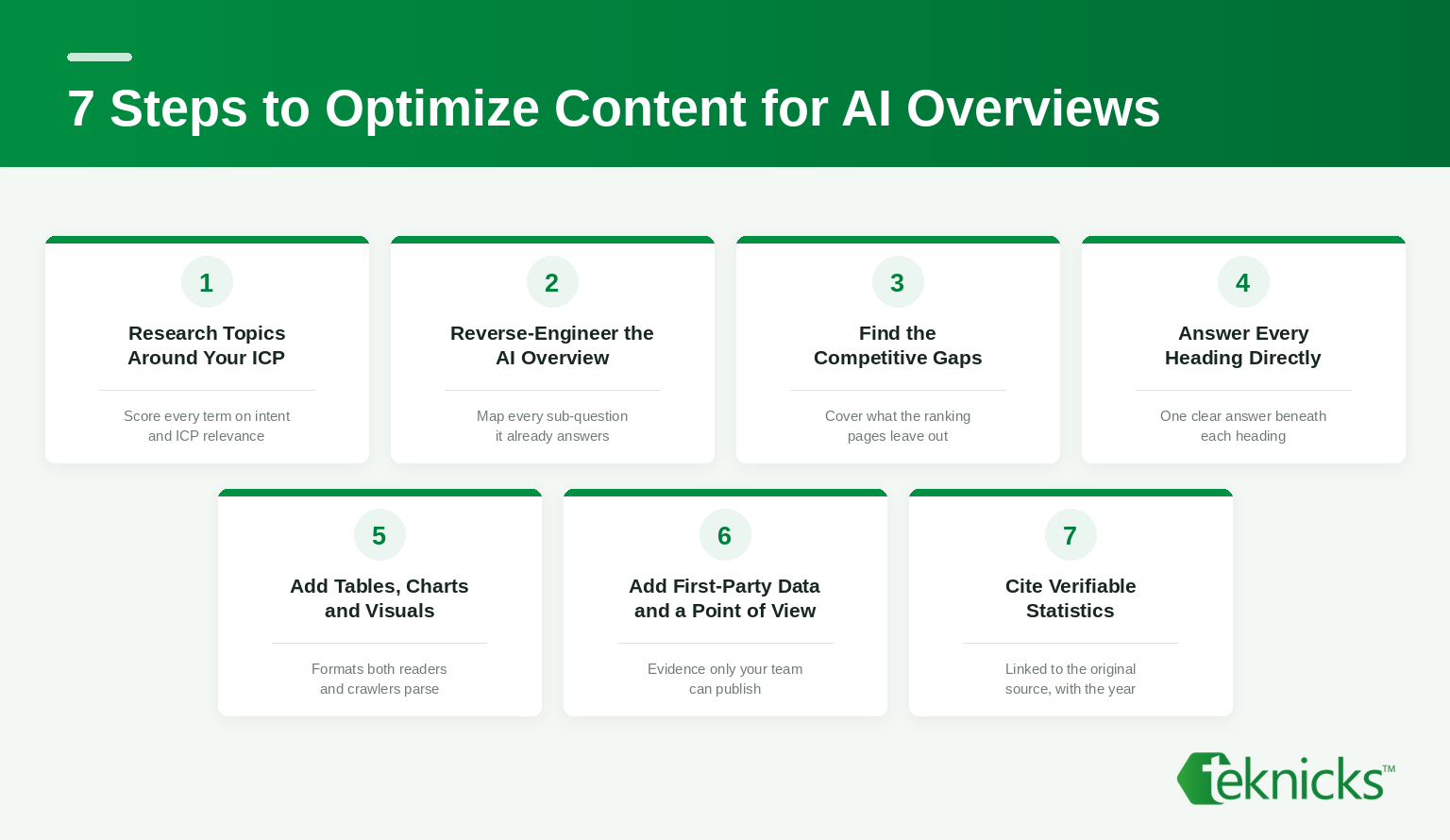
Learning how to optimize content for AI Overviews starts with a mindset shift: the click is no longer the finish line, the answer is. AI Overviews now sit above traditional results and resolve a question before a reader ever visits a page. Optimizing for them means making a crawlable page that answers a question directly, with real evidence behind it.
That change rewrites the visibility equation for marketing leaders. Impressions now happen upstream, and the pages that get cited are the ones built to be lifted.
This page outlines a repeatable process, grounded in first-party data, that Teknicks runs for every page we publish. Follow it in order and you can apply it to content you already own.
What AI Overviews Are and Why They Matter for Visibility
AI Overviews are AI-generated summaries that appear at the top of a search results page, synthesizing an answer from multiple sources and citing a small set of them.
They pull information from across the web, stitch a response together, and place it above the traditional blue links. For most informational queries, that answer is the first thing a reader sees.
For B2B marketing leaders, the stakes are concrete. Influence now happens before the click. Your brand can be referenced in an AI Overview, shape a buyer’s understanding, and never register as a session in your analytics. That is why visibility has to be measured differently than it was three years ago. Impressions, citations and share of answers matter alongside traffic.
For a fuller treatment of what this does to click behavior and pipeline, see our breakdown of the impact of AI Overviews.
How AI Overviews Select and Cite Content
AI Overviews work by retrieving relevant passages, selecting sources that answer the query, and citing the ones that answer it most clearly.
The mechanism worth understanding is query fan-out. A single search is expanded into a set of related sub-questions. The system then pulls sources to answer each one, not just the original phrasing. A query about optimizing content might fan out into questions about crawlability, structure, authority and measurement, each drawing from different pages.
Relevance, clarity, structure and authority all influence whether your page gets referenced. A passage that answers a question in isolation can be lifted in isolation, which is why self-contained sections perform better than sprawling ones.
We are not speculating about ranking factors or claiming insider knowledge of the model. This is the strategic logic behind why the tactics below work. If a section on your page cleanly answers a sub-question the AI Overview needs, it becomes a candidate for citation. If it buries that answer inside a wall of context, it does not. Everything that follows is built on that single idea.
Start With Crawlability Before You Touch the Content
None of this framework works if the page cannot be crawled and rendered. Crawlability is the first check.
AI crawlers need access to the same content a human sees. If your best answer only appears after JavaScript runs and is missing from the rendered HTML, it may as well not exist.
Run these checks before you write a word:
- Robots.txt directives that accidentally block AI or search crawlers
- Noindex tags left on pages you want surfaced
- Canonical conflicts that point authority at the wrong URL
- JavaScript-dependent content that never appears in the rendered HTML
- Orphaned pages with no internal links pointing to them
- Broken internal links that strand crawlers before they reach the content
How to Optimize Content for AI Overviews
The steps below run as one repeatable system. Teknicks applies all of them to every page, in order.
The order matters. Skipping the research steps is exactly what produces the generic, interchangeable content. Do the research first, structure second, and prove your claims last.
1. Start With Keyword and Topic Research Tied to Your ICP
Content work starts with keyword and topic research for the specific page you are building, filtered through your ideal customer profile.
Here is how we run it. We scrape the top-ranking page for the target query and pull the full set of keywords in the top 10 results, nonbranded, that page already ranks for. We also consider long-tail variations and semantically-related queries. Then we evaluate the intent behind each keyword, weigh it against the ICP and business goals, and score every keyword on relevancy to both.
The scoring is the point. It separates keywords worth owning from keywords that only look valuable in a search-volume column. A high-volume term with the wrong intent will bring traffic that never becomes pipeline.
| Keyword | Monthly Volume | Intent | ICP Relevance | Business Relevance | Score |
| how to optimize content for ai overviews | 720 | Consideration | High | High | 8 |
| ai overview content optimization | 480 | Consideration | High | High | 8 |
| what are ai overviews | 2,400 | Informational | Low | Low | 3 |
| free ai content generator | 6,600 | Conversion | Low | Low | 5 |
From there, we group keywords into topic clusters. Clusters make it clear which keywords belong to which topic and which page should own them.
2. Reverse-Engineer What the AI Overview Already Shows
Pull the live AI Overview for your target query, break it into the sub-questions it answers, and build a page that answers each one more directly and more completely.
The method is straightforward:
- Search the target query and capture the full AI Overview.
- List every sub-question the Overview resolves.
- Note which sources it cites and what format each source uses.
- Map each sub-question to a heading on your page.
- Add headings for gaps the Overview leaves open.
Every heading on your page should map to something the Overview surfaces or to a gap it does not fill. This is the step most competitors skip. It is why their advice stays generic and why their pages read like summaries of one another. When you answer the actual sub-questions behind the fan-out, you give the model a reason to cite you instead of them.
3. Run a Competitive Analysis to Find the Gaps
The brief for every page is built from a competitive analysis that identifies what competing pages cover, what they miss, and which sections are worth carrying forward.
We look at the pages currently ranking and the Overview sources, then map their coverage against the sub-questions from the previous step. Sections that recur across competitors get included when they genuinely apply to the business and the ICP. A definition everyone covers stays because readers expect it. A generic on-page SEO primer gets cut because your audience already knows it.
The output is a heading structure that flows logically and covers the topic more completely than anything currently ranking and showing up in AI Overviews. Every inclusion decision ties back to ICP and business goals, so this never becomes a copy-the-competitor exercise. You are filling gaps.
4. Structure Every Section to Answer Its Heading
Write clear headings, then create content directly beneath each one that succinctly answers the question or subtopic the heading raises.
Apply these rules to every section:
- Follow SEO best practices in terms of heading structures
- Keep sections short and single-purpose
- Hold paragraphs under 75 words
- Use bulleted lists for parallel items
- Use numbered lists for sequential steps
- Open with a definition when the heading names a term
Here is the difference in practice:
Buried: There are many factors that go into whether a page appears in an AI Overview, and over the years marketers have debated which ones matter most, but generally speaking the consensus has shifted toward the idea that structure plays a meaningful role.
Direct: Structure influences AI Overview citations because a self-contained passage can be extracted as a self-contained answer.
The second version answers the question in one sentence. This article is deliberately built the way it recommends. Scroll back and check any heading against the sentence beneath it.
5. Use Tables, Charts and Visuals to Make Content Scannable
Structured formats give both readers and AI systems a clean way to parse relationships that prose buries.
Match the format to the job:
- Tables for comparisons and side-by-side data
- Charts and graphs for trends and quantities
- Annotated screenshots for process steps
The practical requirements matter as much as the format. Use descriptive alt text so the content is legible to crawlers. Build real HTML tables rather than images of tables, since an image of a table is invisible as data. Add captions that state what the visual shows, and reference the visual in your body text rather than assuming the reader connects it.
6. Add Authority Signals With First-Party Data and a Real Point of View
What separates a page worth citing from a page worth summarizing is first-party data and a perspective nobody else can publish.
Most B2B teams already sit on evidence they underuse:
- Internal benchmarks
- Proprietary survey results
- Patterns from sales and support conversations
- Product usage data
Data alone is not enough. A page also needs a real point of view: a stated position, an argument competitors are not making, and named tradeoffs. That is what earns the citation and what strengthens E-E-A-T in a way no checklist replicates.
See how AI-driven discovery is impacting your pipeline.
Explore our AEO services
7. Support Every Claim With Verifiable Facts and Statistics
Support every claim with current, verifiable facts and statistics, cited and linked to the original source rather than to an aggregator quoting it.
Check that a statistic is still current before you use it. Trace it back to the primary publisher, confirm the publication date, and drop anything older than two years, for example, for a claim about AI search behavior. A 2019 number quietly undermines a page about a landscape that changes every quarter. The exact timeframe will vary based on industry.
Pages built on verifiable data earn citations and links. Facts and statistics pages are one of the most reliable link-earning content types available to a B2B team, because other publishers reference them by default.
Include the publication year alongside every statistic. Dated evidence is easier to trust and easier to cite, which is the entire goal.
Prioritize Existing Content Before You Build New
Most teams respond to AI Overviews by commissioning new content. The fastest gains sit in pages that already exist and already have authority.
Three priorities come first, in this order: low-hanging fruit that already ranks, refresh and merge candidates surfaced by an audit, and net-new content built specifically to earn links.
Low-Hanging Fruit: Pages That Already Rank
Pages already sitting in top positions have earned authority, which makes them your fastest candidates for AI Overview visibility.
The move is simple: apply the structural and authority work above to a page that already ranks, instead of starting from zero. The relevance signals are in place, so restructuring and adding first-party evidence compounds on top of them.
This is exactly what produced a 50% month-over-month impression increase on a refreshed professional services service-area page. It began appearing for queries tied to its core topic, alongside authoritative .gov sources.
The ceiling on a refreshed page is often higher than on a new one, because the authority is already banked. You are amplifying trust, not building it from scratch.
Refresh and Merge Candidates From a Content Audit
A content audit is what tells you which pages already exist, which are refresh candidates, and which should be merged.
Merging matters more than most teams expect. Multiple thin pages targeting the same topic split your signals and cannibalize each other. Consolidating them into one authoritative page usually outperforms keeping both, because the combined page carries the full weight of the topic.
The audit is also what keeps a content program from manufacturing the cannibalization problem it will later have to fix. Publish without one and you create competing pages by accident.
New Content Built to Earn Links
New content is the right call when the topic has no existing page to build on and when the format can earn backlinks.
Facts and statistics pages are the clearest example. Other publishers cite them, which builds the off-site authority that supports every other page on your site.
A refreshed B2B SaaS statistics page produced a 36% increase in AI Overview impressions, and pages like it tend to accumulate links over time.
New link-earning content still has to run through the same research, structure and citation steps above. Skip them and it becomes another page nobody references.
How to Optimize Content for AEO Beyond Google
Learning how to optimize content for AEO means preparing for answer engines beyond Google, including ChatGPT, Perplexity, and Claude. Answer engine optimization applies the same core discipline across every assistant.
What carries across every platform is consistent:
- Crawlable pages
- Clear structure
- Direct answers
- Cited, verifiable data
- Off-site authority
What differs is retrieval and citation behavior. Each platform pulls from different sources and displays citations differently, so measurement has to be platform-specific. No single dashboard covers all of it.
A multi-platform approach is protection against fragmenting discovery, not a separate discipline. You build one strong page and measure how each engine treats it.
For a closer look at one platform, see our guide to visibility in ChatGPT.
How to Measure AI Overview Content Optimization
Effective AI overview content optimization is measured by tracking impressions, the gap between impressions and clicks, assisted conversions, and traffic quality rather.
Track these signals:
- Impressions on pages appearing in AI Overviews
- The widening gap between impressions and clicks, which is expected, not a failure
- Assisted conversions from sessions that touched an Overview upstream
- Traffic quality, measured by fit and pipeline contribution, not session count
Attribution is genuinely hard here, and pretending otherwise erodes trust with an executive team. Report what you can defend. Month-over-month impression movement is the earliest reliable signal that structural changes are working, and it is exactly how the results cited earlier in this article were measured. Frame it as leading-indicator progress, not final ROI, and pair it with pipeline over time.
Common Mistakes That Keep Content Out of AI Overviews
Four mistakes account for most missed AI Overview citations. Each carries a direct consequence.
| Mistake | Consequence |
| Publishing on pages that are not crawlable or renderable | The content is invisible to AI crawlers and cannot be cited at all |
| Burying the answer beneath a long introduction | The passage cannot be lifted cleanly, so a competitor’s direct answer gets cited instead |
| Chasing keyword volume instead of topic coverage and intent | You attract traffic that never converts and miss the sub-questions the Overview actually asks |
| Making claims with no data or first-party evidence | Your page gets summarized rather than cited, and earns no links |
None of these are complicated to fix. They persist because teams treat structure and evidence as optional polish rather than the foundation.
What Should You Fix First?
Work the priorities in order. Confirm crawlability first, since nothing else matters if the page cannot be read. Audit your existing content for low-hanging fruit and refresh candidates. Reverse-engineer the AI Overviews for those queries. Restructure so every section answers its heading. Then add first-party data and cited statistics.
This results compound when you run it as a system. If you want a senior team to run it with you, schedule a strategy session with a strategist.