
 Alyssa Kulka
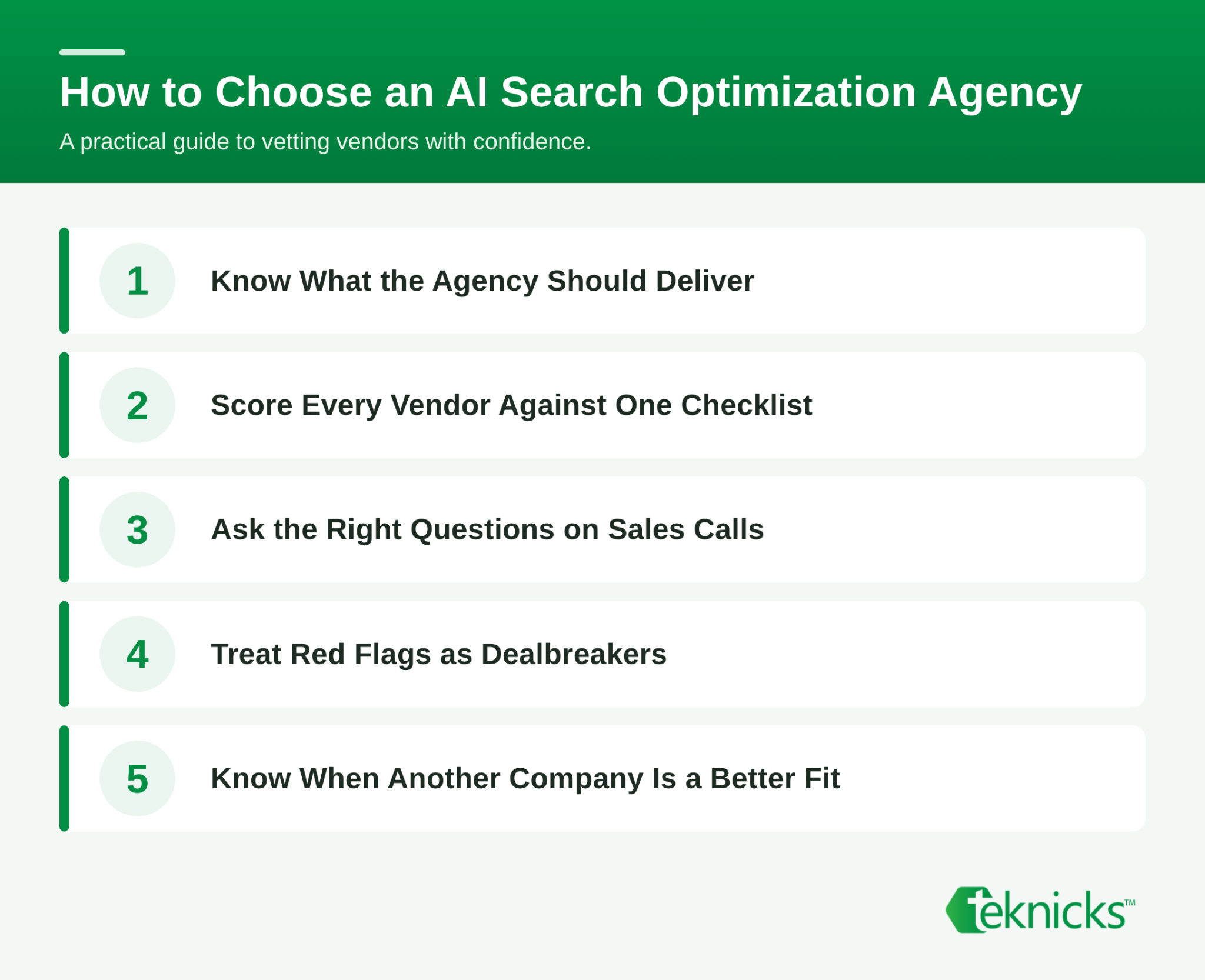
To choose an AI search optimization agency, you need a way to separate AI search work from rebranded search engine optimization (SEO). Every vendor claims AI expertise, the proposals blur together, and your CEO wants to know how ChatGPT, Google AI Overviews, and Perplexity will affect pipeline.
This guide gives you a vendor checklist, the questions to ask, the red flags to watch for, and an honest look at when another company is the better fit.
What Is AI SEO?
AI SEO is the work of getting your brand cited and recommended when buyers ask AI tools like ChatGPT, Perplexity, and Google AI Overviews about your category. It goes by a few names, including answer engine optimization (AEO) and generative engine optimization (GEO), but the goal is the same.
What Should an AI Search Optimization Agency Deliver?
An AI search optimization agency should deliver three things:
- Real AI visibility tracking. It measures actual citations in ChatGPT, Perplexity, and Google AI Overviews, not rebranded SEO reports.
- Off-site authority. It builds your presence on the third-party sources AI models pull from.
- Pipeline impact. It ties that visibility to qualified pipeline.
If a vendor can't do all three, it's selling you reports. For example, an HR software company needs more qualified demos, not more citations in a dashboard. The checklist below turns these three outcomes into criteria you can verify.
AI Search Agency Evaluation Checklist
A qualified AI search agency should meet every item below. Score each vendor the same way, from visibility to pipeline to delivery.
- AI citation tracking: Verify they track share of voice and citation frequency across ChatGPT, Perplexity, Gemini, and Google AI Overviews using specific tools.
- Entity and knowledge graph work: Confirm they optimize organization schema, leadership profiles, and directory listings.
- Off-site citation building: Ensure they build presence across review sites, roundups, publications, and communities.
- Pipeline measurement: Check that search performance ties directly to sales-qualified leads (SQLs).
- Named case studies: Review named client case studies detailing their specific methodology and results.
- Strategy and execution in one retainer: Verify strategy and execution are bundled together rather than sold separately.
- Senior strategists doing the work: Ensure senior strategists from the sales process execute the work.
- One integrated program: Confirm SEO, content, AEO, and CRO are managed as a single program.
- Updated methodology: Check that their process has evolved within the last 18 months.
Questions to Ask Before You Choose an AI Search Optimization Agency
Ask these eight questions on every sales call:
- Which non-brand prompts and queries will you track to set a baseline?
- How do you separate branded mentions from category discovery?
- Which third-party or unowned sources will you target to get us cited?
- Can you walk through a case study where AI citations turned into revenue?
- Who will work on our account each week?
- Who writes the content, ships technical fixes, and publishes changes?
- What has changed in your process over the last 18 months?
- What would make you tell us we're not a fit?
Pay close attention to the last answer. An agency that can't describe a bad-fit client will likely take any client.
Red Flags When You Choose an AI Search Agency
When you choose an AI search agency, these red flags should end the conversation:
- Guaranteed ChatGPT or AI placements. No one controls what models cite, so a guarantee is a promise they can't keep.
- Vague answers about tools or prompts. If they can't name what they track, they aren't measuring it.
- Branded mentions counted as wins. Without separating category discovery, the reporting flatters itself.
- Anonymous case studies. Big percentages with no named client and no method.
- Strategy-only deliverables. Your stretched team is left to execute a plan it can't run.
- Senior sellers, junior doers. The experts close the deal, then hand you off.
- Legacy SEO with a new label. Only the pitch has changed; the process hasn't.
Want a second opinion before you sign? Request a strategy session with a senior strategist.
How Teknicks Handles Strategy and Implementation
Teknicks handles strategy and implementation as one program, run by the same senior team, through our Search-to-Pipeline methodology. The people you meet on the first call build the plan and carry it through execution, so nothing gets lost in a handoff between strategists and doers.
Let’s look at our methodology:
Map the Buyer Demand That Matters
Teknicks builds strategy in the Map stage, starting with buyers. Map combines customer insight, Jobs-to-be-Done research, search and AI question research, competitor research, and sales intelligence.
The output is a prioritized set of high-intent buyer questions, competitor and market gaps, and revenue opportunities. This is also where the non-brand prompt baseline gets set. Every recommendation leaves this stage with an owner and a timeline, so the plan is ready to execute.
Capture, Influence, and Convert
We implement the plan across three stages:
- Capture: Buyer Capture Pages; technical SEO and AI search foundations; category, competitor, and alternative content; and use-case and industry content.
- Influence: Review and rating presence, editorial coverage, community and citation building, and third-party source strengthening. This is the off-site citation building from the checklist, and it shapes whether AI models name you.
- Convert: CRO, experimentation, messaging and proof, and conversion path design.
Your role stays light: access, subject matter expert time, and approvals. Teknicks handles the writing, technical fixes, and testing, so your team isn't left executing a plan it has no room to run.
Compound What Works
Teknicks measures results in the Compound stage, which covers search-to-SQL attribution, opportunity and pipeline tracking, and shifting investment toward what produces qualified demand.
Here's the named proof the checklist asks for:
WebMD Health Services saw 69% more qualified demo requests and a 325% increase in ChatGPT referrals, comparing Q4 2025 to Q4 2024.
Compliancy Group saw 60% growth in organic marketing-qualified leads (MQLs) within the first three months.
When Another Company Is the Better Fit
Another company is the better fit when your team only needs strategy, or when AI search hasn't taken hold in your category yet.
Your Team Has Execution Capacity and Only Needs Strategy
If your team can already execute and only needs direction, a strategy-only consultant or advisory engagement fits better than a full-service agency. That usually means you have strong technical SEO, writers with access to subject matter experts, developer capacity to ship changes, and analytics connected to the CRM. You need a sharper plan.
The Teknicks model pairs strategy with hands-on implementation, so a team like yours would be paying for capacity it already has. Look for one that delivers a specific, page-level plan with owners and timelines, plus regular check-ins while your team does the work.
AI Search Volume Hasn't Materialized in Your Category
If buyers in your category still research through peers, analysts, events, and traditional search, hiring an AI search agency is premature. Check whether your buyers are there yet before you pay for AI search work.
Run your top buyer questions through ChatGPT, Gemini, Perplexity, and Google AI Mode. Check Google Analytics 4 (GA4) for AI referral traffic. Ask sales where buyers first heard of you. If AI tools rarely come up, a strong SEO or demand generation partner may serve you better today.
Recheck each quarter, since buyer behavior can shift quickly.
Choose the Agency That Fits Your Pipeline Goals
Choose the agency that can show how its work becomes qualified pipeline, clearly enough to defend the choice to your CEO. That matters more than the longest list of AI tactics.
Compare vendors with the checklist, bring the questions to every call, and treat the red flags as dealbreakers. Be honest about your team, too. If you have execution capacity, or your buyers aren't using AI search yet, another partner may fit better.
Not sure whether an agency, a tool, or an in-house build fits your team? Schedule a strategy session.
Frequently Asked Questions
How Much Does an AI Search Optimization Agency Cost?
AI search optimization agency cost depends on scope, content volume, technical health, and whether the agency includes execution. A cheaper strategy-only retainer can cost more once you add your team's execution time. For ranges, see how much AI search optimization costs.
Should an Agency Focus on ChatGPT or Google AI Overviews?
An agency should focus on both, weighted by where your buyers research. Google AI Overviews reach buyers already in Google. ChatGPT and Perplexity matter more for open-ended comparison questions. A good agency checks your buyer questions and referral data before deciding.
What Is the Difference Between AEO and GEO?
AEO and GEO largely overlap. The difference is emphasis: AEO focuses on being the answer inside AI responses, while GEO focuses on being cited by generative AI tools. Focus less on the label and more on whether the work ties to pipeline.